 | |  | |  | |  | |  | |  | |  |
 | |  | |  | |  | |  |

Copyright 2006 by EA Tischler - New Horizons Golf Approach. All rights reserved.
| New Horizons Golf Approach I n n o v a t i v e C o a c h i n g F o r G o l f e r s |
| Deliver a square clubface!! It has the basic descriptions of managing a square clubface. |
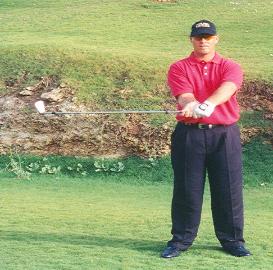

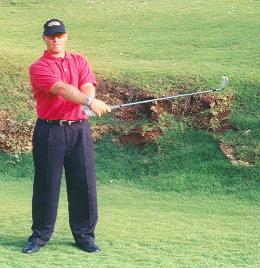
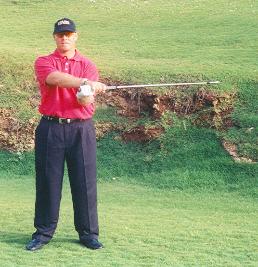
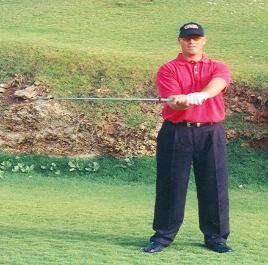
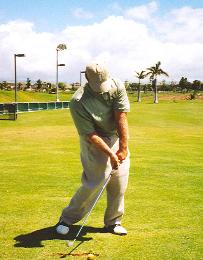
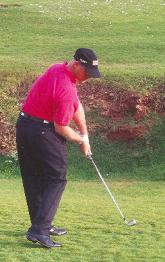
The 2 pictures to the left show how the clubface is square-to-the-arc of the swing as the swing approaches impact. |

If you have any questions regarding New Horizons Golf Approach please contact EA Tischler at (408)203-7599, or email your questions to EA Tischler newhorizonsgolfer@yahoo.com. |
 |  |  |  |  |  |  |
| The following article is copyrighted by EA Tischler. It is an excerpt from his book New Horizons Golf - A Physical, Mental, & Inner Renaissance. All rights reserved. Your hand action controls the squareness of the clubface. What we commonly call hand action is actually wrist action. Your hands hold the club, and your wrists hinge. So, the hinging of the wrists is what we call hand action. Your hands grip the club, and your grip maintains the alignment between the clubface and the palm of your dominant hand. The way your wrists move will determine how squarely you control the clubface. Your wrists can hinge in two basic directions, vertically and horizontally . I choose to call the vertical hinging of your wrists, "cocking." This is because wrist-cock is the common name given to the hinging of the wrists, and vertically cocking the wrists is taught most commonly. However, this traditional way of cocking the wrists is not the only way, and it may not be the best way for you. Of course, traditions die hard, and some players will insist on using wrist-cock. I'm going to describe both actions; practice feeling both of them. Then you can decide for yourself, which one is more effective. I call horizontal hinging of the wrists, "setting." I choose "setting" because when you hinge your wrists horizontally there's a feeling of them being firmly "set." Therefore, wrist-set will refer to the horizontal hinging of your wrists. Since there are two basic ways of hinging your wrists, there must be two basic ways of managing the squareness of the clubface. To understand the difference between the two hinging actions, hold the club in front of you so that the shaft of the club is parallel to the ground and the clubface is square to the centerline of your body. Now imagine you're going to swing the club around your body keeping the shaft of the club parallel to the ground. You can imagine swinging the club across the top of a table. In this image the tabletop would be the plane of the swing. As you keep the shaft parallel to the ground, there are two basic ways you can control the clubface. You can roll the clubface so that it lies on the plane of the swing, or you can keep the clubface square to the path of the swing. Rolling the clubface back-n-forth involves "cocking" the wrists and rolling the forearms, and keeping the clubface square to the path involves "setting" the wrists without rolling your forearms. As you can imagine, if you are rolling the clubface back and through, squareness of the clubface as the swing moves through the ball can be quite difficult. Of course, if you practice hundreds of balls a day, like most tour professionals, you might be able to manage this action. It may be easier to keep the clubface square-to-the- arc. In theory it definitely will be easier to square the clubface if it's already square-to-the-arc. The question becomes, which way of managing the clubface will work best for you. No matter which one you use, you'll have to deliver the clubface square-to-the-arc of your swing as you move through the ball. One reason the rolling action is more difficult is because you must coordinate two actions simultaneously as you square the clubface. You must roll your arms because when you cock your wrists the shaft moves off the plane of your swing, and rolling your forearms moves the shaft back on plane. However, if you hinge your wrists horizontally, the shaft stays on plane as you set the clubface square-to-the-arc. Therefore, there's no need to roll the arms. Both of these actions can be seen more clearly if demonstrated from your address position. Again, both actions can be performed effectively. The question is, which one will work best for you. You may actually find it depends on what type of shot you want to play. But for now we'll focus on trying to become more aware of how each one feels. Traditionally it's argued that you'll gain more power through leverage if you cock your wrists. Compared to not hinging the wrists at all, this is true. However, hinging your wrists horizontally produces greater leverage than vertical hinging. Therefore, setting your wrists provides more power than cocking your wrists. Once again, this is a great theory, but we still need to find out which one works best for you. When you cock your wrists and roll your arms, the clubface is traditionally said to be square at the top of your swing. I'd like to clarify this description, and try to understand why it's square. My question is, what's it square to? I believe the clubface is actually lying on the plane of the swing. Therefore, I believe cocking your wrists and rolling your forearms in this manner places the clubface on-plane instead of square. If the clubface remains on-plane as you swing through the ball, then the clubface will be wide open through impact. This is why traditional teachings tell you to roll your arms or hands as you swing through the ball. Since traditional teaching wants you to swing the clubface on-plane, you need to roll your arms in order to deliver the clubface square-to-the-arc. When you "set" your wrists and swing the club without rolling your arms, the clubface remains square-to-the-arc of your swing, and will remain square as you move through the ball as long as you don't roll your arms. Therefore, on-plane clubface swingers need to roll their arms to square the clubface, and Square-to-the-arc clubface swingers need not roll their arms. Both actions can be effective. You simply need to be aware of the correct combination of arm action and wrist action. So, a square clubface is not on-plane through the ball, it is square-to-the-arc. Again, I'm not trying to convince you to do one or the other. I'm simply trying to paint a picture of your options. If you choose to "set" your wrists so the clubface is square-to-the-arc, you are sure to be told that your clubface is closed at the top of your backswing. So I ask the question, what's it closed to? It's actually square-to-the-arc of your swing. Many great golfers have played this way. From Tom Watson, to Greg Norman, to Paul Azinger, to younger players like David Duval. It's often said that these players are strong and get away with having such a closed clubface. In reality it's a fundamentally sound way of swinging. These players are very accurate, and they aren't lacking power either. It hasn't always been that a square-to-the-arc clubface was considered bad. There's a common teaching image that you should set your dominant hand at the top of your swing in such a way that you feel you'd be holding a waiters tray. If you were to hold a waiters tray at the top of your backswing, the palm of your dominant hand would be facing the sky. If your palm is facing the sky, then your clubface will be facing the sky. Therefore, at least one famous instructor must have believed it was all right to swing the clubface square-to-the-arc. I've also heard that Claude Harmon (a famous golf instructor) use to say, "there are open face players, and there are closed face players." I believe he meant that some great golfers manage the clubface while swinging it on-plane, and others play great golf while managing the clubface square-to-the-arc. I want you to try a test. It will show the effect that each individual hand has on the way you manage the clubface. Set- up to a ball, close your eyes, then while holding the club with only your dominant hand, take the club away to waist high in the backswing. Stop and look at where the clubface is facing. For most golfers it'll be facing down a little, or a little back towards the ball. The natural thing to do is to hold the clubface square-to-the-arc of your swing. Most golfers do this unless they've deeply internalized an on-plane clubface action. Now that you have the club at waist high, rotate your arm so that the clubface is looking more down, and notice how it feels. Then rotate your arm so that the clubface is looking more up, and notice how it feels. Rotate the clubface back-n-forth. Have it look more down, then more up, more down, then more up. Finally, settle on the position that feels more natural with the most control. Be open and honest with yourself. You shouldn't have thoughts of what's right and wrong. You're simply pay attention to what's most natural. Now reverse the process. Make the takeaway with only your non-dominant hand holding the club. Set-up, close your eyes, and take the club away to waist high in the backswing. Hold the position, then open your eyes and look at the clubface. Is it facing more up or down? Does it feel natural? Remember, your goal is to see what would happen if you took it away with your non-dominant hand in control. For most players, the natural thing to do is to position the clubface on-plane; although some ambidextrous players may instinctively set it square-to-the-arc. As you hold the position, rotate your arm so the clubface looks more down, then more up, then more down, then more up. Now settle on the position that's most natural, the one that's easiest to hold. Most of you will find the clubface positioned more toe-up at this point. The reason each individual hand action is different is because of your physiology. As you take the club away with your dominant hand, the most stable way to support the club, physiologically, is by holding the clubface more square-to-the-arc. If you take the club away with your non-dominant arm only, the most stable way to support the club is to roll the arm slightly as it moves across the front of your body. As the arm rolls slightly, it's easier to hold the clubface more on-plane. Therefore, physiologically it's beneficial to control your swing with one side of the body, or the other. Whatever side is in control, the other should go along for the ride. Since we're learning New Horizons Golf, and since New Horizons Golf uses the natural premise, I urge you to control the club with your dominant hand. Therefore, New Horizons Golfers tend to manage the clubface more square-to-the-arc. However, let your experience prove to yourself which way is best for you. In the last paragraph I described the actions as being more square-to-the-arc and more on-plane. I described it this way because it's been my experience that once a golfer has found a natural "set" the clubface is always aligned somewhere between being on-plane and square-to-the-arc. Since we're all built differently, the exact positioning of the clubface, once you've set your wrists at the top, will look different than the next golfer. The key is to learn to hinge your wrists in the most natural way that provides control of the clubface. You shouldn't try to make the clubface look a certain way. You should become aware of how to manage the clubface squarely. Whatever hinge action gives you the best control of the clubface will be best for you. Let's get back to dominant hand control. Many people argue that controlling the club with your dominant hand leads to hooking the ball. Actually, hooking the ball is caused by rolling the clubface closed as you swing through the ball. With the square-to-the-arc method, there's no need to roll the clubface over. You simply release the club squarely. We can also disprove the theory of too much dominant hand leading to hooking the ball by practicing swings with only your dominant hand holding the club. With only your dominant hand holding the club, you can play shots perfectly straight. You can even work the ball from right to left, and left to right. Since all dominant hand is the most dominant hand you can use, and since you can play the ball straight with all dominant hand holding the club, too much dominant hand does not lead to hooking. Again it's the rolling of the hands in the forward swing that causes the hooking action. This whole argument has intrigued me since I was a boy. I remember thinking, OK, they want me to roll the clubface toe-up in the backswing, and toe-up in the follow-through, then when I roll the clubface a little bit too early they say I used too much right hand (I am dominantly right-handed). Therefore, they say I need to pull through more with my left hand. However, if I pull through with my left hand too much, then the clubface will lag open and I'll slice the ball." When I thought of this as a boy, I realized that it wasn't which hand I used that determined how accurately I'd control the clubface. I realized it was how I used my hands. Therefore, proper hand action would manage a square clubface. So I set out to find a more natural way of managing the clubface. Throughout my years of coaching I've also come to learn that such players as Ben Hogan, Tommy Armour, and Moe Norman have all advocated using the right hand, their dominant hand. Hogan even said once that, "he wished he had three right hands." I'm sure you will find that using dominant hand action in your swing, is not only beneficial, it is fundamentally sound. The reason I've spent so much time describing this action, is because it's the most controversial and misunderstood of the fundamental actions. Traditional teachings are rooted back in the age of hickory shafts when a rolling release was desired. However with the advent of steel and graphite shafts you have another possibility open to you. I know old habits and traditions die hard, so I am going to give the skeptics one last argument as to why squaring the clubface to the arc of your swing is fundamentally sound. This argument is going to come in four parts. The four parts have to do with Byron Nelson, Ben Hogan, Sam Snead, and hickory shafts. All three of these great players learned golf during the age of hickory. When each of these players switched from playing hickory shafts to steel shafts they began hooking the ball. This was simply because the rolling release action needed for hickory did not work for steel. Each of these players began looking for a way of correcting the hook. Actually, they were looking for a way of delivering the clubface square-to-the-arc with steel shafted clubs. However, in effect, they were combating the rolling release they'd already internalized. You on the other hand are simply trying to become aware of what options are available to you. Byron Nelson chose to use a lateral sliding action to delay the release of his hands. He firmed up his set, and drove his weight laterally to the target. This delayed the rolling over of his release. Though he found this method effective, he once wrote that he didn't need to exaggerate the lateral slide as much as he did. As Nelson's popularity grow, many golfers and teachers began to emulate him. Teachers began focusing on driving their knees towards the target as Nelson did, then they focused on keeping their heads still to stabilize the swing. This lateral motion was eventually coined the "Caddy Dip," and it evolved into the "Reverse C" style of play in the seventies. Ben Hogan did a couple of things to combat the hooks. He weakened his grip tremendously so even if he did roll the release a little early, he wouldn't hook the ball. Such a weak grip demands the use of very strong and supple hands. Hogan also performed one more action he called, "supination." Supination means, "Palm up." For Hogan this meant left palm up. If his left palm was facing up, his right palm, or dominant palm, was facing down. The importance of this is that Hogan felt he would reach this supinated position by the time his swing was waist high on the down swing. We call this position "delivery," because it's the point in the swing where you're ready to deliver the clubface through the ball to your target. If the palm of the dominant hand was facing down at delivery, then the clubface was now more square-to-the-arc. From that point on, Hogan's hand action held off any rolling over of his hands until well past his extension. Therefore, although Hogan's weak grip, and cocking wrist action in the backswing developed a more on-plane clubface alignment in the backswing, Hogan's forward swing focused on delivering the clubface square-to-the-arc. I feel understanding this secret is one of the things that made Mr. Hogan a great ball striker. This was a revelation for me, because it proved to me that no matter what type of takeaway, backswing, and downswing you make, to consistently play accurate shots, you must deliver the clubface in a square-to-the-arc manner. Sam Snead developed what was called the "late hit." What this meant was he delayed his rolling release long enough that it would not roll over prior to the clubface catching the ball. Of course, this method demanded greater timing and rhythm. However, Snead was exquisite with both his rhythm and his timing. Also, Snead being ambidextrous was able to hold off this late release with his left hand in control. This enabled him to play what was called a "body-pull." The combined actions produced a controlled fade. Then when he wanted to draw the ball, he would simply let his release go. The last part of this argument has to do with the traditional means of dealing with the average golfer who had to make the transition from hickory to steel. The traditional method was to use your left hand to pull through impact in an effort to delay the already internalized action of a rolling release. The method was developed to combat a bad habit. Actually, it was a good habit for hickory, but a bad habit for steel. However, what about all those golfers who never used hickory, instead started with steel? How's the pull with the left hand method worked for them? A quick review of the past six decades of golfers will show that the average golfer has become a slicer of the ball. This is because, pulling through with the left hand lags the clubface open. The longer you pull with the left hand, the more you'll lag the clubface open, and the more you'll slice. To combat the slice, teaching methods have reverted back towards the rolling release method. Now if you roll to soon, you hook the ball, and you've used too much dominant hand. If you pull through too much with your left hand you slice the ball, and they say you did not release the club to your target. Both teaching methods ignore the fundamental action of squaring the clubface to the arc of the swing. They're stuck between a method that worked for hickory, and a correction for a bad habit for those who learned on hickory. However, you're concerned with becoming aware of what works for you and the equipment you're playing with today. So let's practice delivering the clubface square-to-the-arc. To do this you're going to feel a square-to-the-arc "delivery set." From this delivery set, you can find the best way of swinging. Some of you may still prefer to cock and roll during the backswing. If so, you'll need to return the club through a square-to-the-arc delivery. Others of you will prefer to maintain a square-to-the-arc set throughout your swing. The first thing you're going to practice is feeling your delivery position. To find this delivery position, get set-up, then take the club away to waist high while holding the club only in your dominant hand. Stop at waist high, and find the natural set position. Now reach your non-dominant hand over and take hold of the club with both hands. When both hands are comfortably on the club, check the clubface position so that it feels square-to-the-arc. Hold this position for a few seconds. Then swing the club up to the top of your backswing. Pause at the top to feel a naturally firm set. Then return your swing back to your delivery position. Pause again, and check how square-to-the-arc your delivery-set feels. Repeat this drill a few times to get the feel of a good delivery set. Remember, try to be aware of how a good delivery-set feels. Now let's practice two different takeaways. Let's try the "cock-n-roll" takeaway, and a "square-to-the-arc" takeaway. To practice the "cock-n-roll" takeaway, assume your address position then cock your wrist so that the club hinges straight up towards your nose. The shaft of the club should be half way between parallel to the ground and vertical. Now roll your arms so that the shaft is parallel to your target line. You've just completed the "cock-n-roll" takeaway. From this position, swing to the top of your backswing, pause for a couple of seconds and feel your top-set. Does it feel strong, weak, loose, or firm? What does it feel like to you? After the pause, return the club to waist high on the downswing. Pause in your delivery position, and feel the clubface alignment. Is it on-plane or square-to-the-arc? If it's on-plane, adjust it to square-to-the-arc. If it's square-to-the-arc, adjust it to on-plane. Adjust it back-n-forth until you feel your best set. Your best feeling set will feel firm, strong, and loaded. It will have a sense of resistance and power. Ok, let's try the "square-to-the-arc" takeaway. Assume your address position again, then set your wrists horizontally so that the shaft stays on its initial plane until the club reaches waist high in your takeaway. The shaft of the club should now be parallel to the ground, and parallel to the target line. Pause there for a second, then release the set back to address. Once again, set your wrists horizontally keeping the clubface square-to-the-arc. Pause for a second then swing the club to the top of your backswing. Pause at the top, feeling your top-set, then return to your delivery position. Once in your delivery position, pause for a second and check the alignment of the clubface. Is it square-to-the-arc? Is it on-plane? Which position has the best feeling set. Which one instinctively feels more powerful? Rotate the clubface back-n-forth between a square-to-the-arc delivery-set, and an on-plane delivery position. Find for yourself which one feels instinctively the best. Which one feels most natural? Which one will be easiest to return the clubface square-to-the-arc? Either takeaway can get the job done. However, you'll have to deliver the clubface square-to-the-arc. As you continue to practice these motions, it's a good idea to practice them in front of a mirror. Mirrors can give you valuable feedback. You don't need to decide what's best for you the first time you practice these drills. Practice them over and over until you're truly aware of what's best for you. |

Square Clubface!
 | |  | |  | |  | |  | |  | |  |
 | |  | |  | |  | |  | |  | |  |
 | |  | |  | |  | |  |
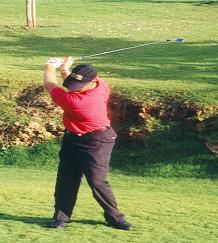
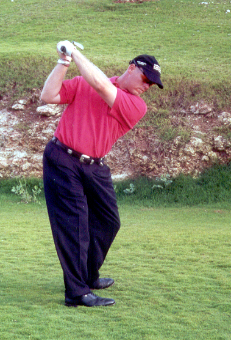
| The 3 pictures above demonstrate a square-to-the-arc clubface path while using horizontal hinging. This type of hinge action requires more rotation by the body. Notice how I am rotating my body slightly toward the target (far right picture above) to help accommodate the square-to-the-arc release. The 3 pictures below demonstrate a rolling hinge action. This method requires more precise timing thru the ball. |
| The 2 pictures above show a square-to-the-arc top of the backswing position. Notice how the clubface is facing more toward the sky. |
| The picture above shows more traditional clubface position at the top. It demonstrates an on-plane clubface position where it mirrors the left arm. |
| New Horizons Golf - A Physical, Mental, and Inner Renaissance is directed toward golfers aspiring to be competitive. It is a comprehensive guide to all aspects of the game, providing over 150 instructional pictures. It also provides drills and exercises for developing the golfers inner and mental strengths. "EA Tischler was my personal coach for 4 years while I was a touring professional. With his help I was able to develop a competitively sound game. He is the most insightful professional I've ever met, and his books have made it easy for me to maintain my competitive edge. New Horizons Golf is a must for competitive golfers. It will help you develop the skills you need to be a competitive golfer, and it will help you develop good mental habits as well as inner strengths. If you have the opportunity, I recommend you visit him in person. Until then, read and study his teachings diligently! I guarantee they will make you a better golfer." Johnny Rieger L.A., California |


Above is the newest Edition of The Way Of The Golfer. It can
be purchased on-line at a variety of on-line book sellers.
However authorhouse.com regularly offers the lowest prices.
be purchased on-line at a variety of on-line book sellers.
However authorhouse.com regularly offers the lowest prices.
Golf - The Timeless Game is a great book for developing your
fundamental skills. It covers all skills from putting to wedge play
to the long game. If you want to purchase this book you need to
buy it directly from E.A. Tischler. Send a purchase request by
email to E.A. Tischler at newhorizonsgolfer@yahoo.com
fundamental skills. It covers all skills from putting to wedge play
to the long game. If you want to purchase this book you need to
buy it directly from E.A. Tischler. Send a purchase request by
email to E.A. Tischler at newhorizonsgolfer@yahoo.com

New Horizons Golf Approach is also a great book for
developing your fundamental skills. It covers the basic long
game fundamentals, athleticism and some inner game issues
you need to address to play your best golf. If you want to
purchase this book you need to buy it directly from E.A.
Tischler. Send a purchase request by email to E.A. Tischler
at newhorizonsgolfer@yahoo.com
developing your fundamental skills. It covers the basic long
game fundamentals, athleticism and some inner game issues
you need to address to play your best golf. If you want to
purchase this book you need to buy it directly from E.A.
Tischler. Send a purchase request by email to E.A. Tischler
at newhorizonsgolfer@yahoo.com

Above is Fore54 Scoring Secrets. It will consist of the Pocket
Coaches volumes 9, 10, and 11 along with Stage 4 Inner
Game skills need to execute those skills on the golf under the
pressures of playing the game. Developing your skills is one
thing, performing them when you have to is another.
Coaches volumes 9, 10, and 11 along with Stage 4 Inner
Game skills need to execute those skills on the golf under the
pressures of playing the game. Developing your skills is one
thing, performing them when you have to is another.
This book covers the New Horizons Golf Approach
Fundamental skills, Ball Striking Skills, Power Stacking Skills
and address Stage 4 playing the game skills. In it you will get
the same information as in Pocket Coach Volumes 2, 4, 5 as
well as valuable Stage 4 playing the game information.
Fundamental skills, Ball Striking Skills, Power Stacking Skills
and address Stage 4 playing the game skills. In it you will get
the same information as in Pocket Coach Volumes 2, 4, 5 as
well as valuable Stage 4 playing the game information.

To purchase full coler eBook click on
PayPal button (right). Remember to
provide your email address. ebooks are
emailed within 48 hours of purchase.
PayPal button (right). Remember to
provide your email address. ebooks are
emailed within 48 hours of purchase.
To purchase full coler eBook click on
PayPal button (right). Remember to
provide your email address. ebooks are
emailed within 48 hours of purchase.
PayPal button (right). Remember to
provide your email address. ebooks are
emailed within 48 hours of purchase.
To purchase full coler eBook click on
PayPal button (right). Remember to
provide your email address. ebooks are
emailed within 48 hours of purchase.
PayPal button (right). Remember to
provide your email address. ebooks are
emailed within 48 hours of purchase.
To purchase full coler eBook click on
PayPal button (right). Remember to
provide your email address. ebooks are
emailed within 48 hours of purchase.
PayPal button (right). Remember to
provide your email address. ebooks are
emailed within 48 hours of purchase.
To purchase eBook click on PayPal button
(right). Remember to provide your email
address. ebooks are emailed within 48
hours of purchase
(right). Remember to provide your email
address. ebooks are emailed within 48
hours of purchase
To purchase eBook click on PayPal
button (right). Remember to provide
your email address. ebooks are
emailed within 48 hours of purchase.
button (right). Remember to provide
your email address. ebooks are
emailed within 48 hours of purchase.
button (right). Remember to provide your
48 hours of purchase.
48 hours of purchase.


MAKING YOUR GOLF SIMPLE APP AVAILABLE - CLICK ON THE PICTURE BELOW FOR MORE DETAILS: