 | |  | |  | |  | |  | |  | |  |
 | |  | |  | |  | |  |

Copyright 2006 EA Tischler - New Horizons Golf Approach. All rights reserved.
Developing a target-oriented Follow-through!! |
The photo gallery below includes a collection of pictures that demonstrate the point to the target, and swing-point actions. |
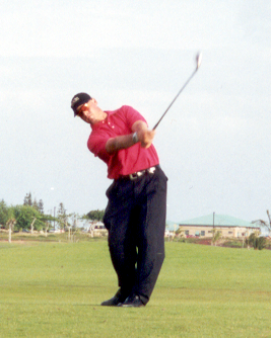
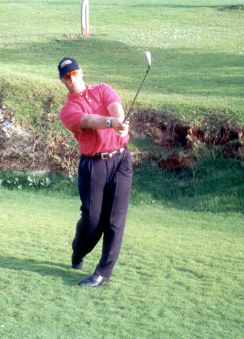
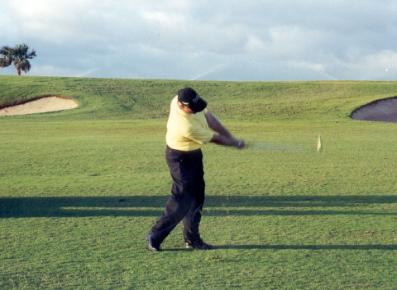
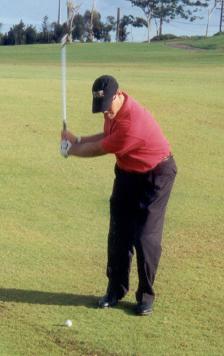
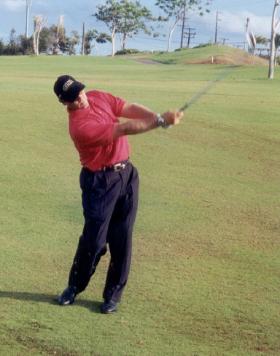

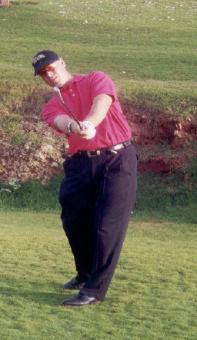
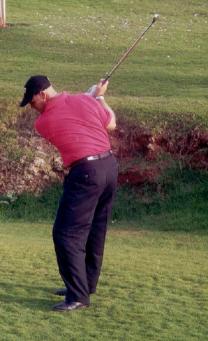
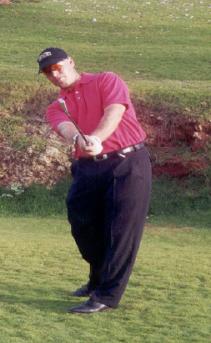


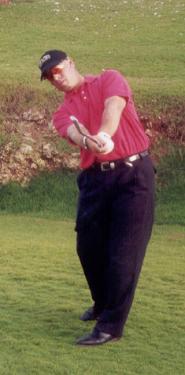
The sequence to the left shows
the swing point action in full
motion. Notice the extension in
the on the right. My right arm
extended thru to the target and
the club was pointing toward the
target before it followed through
past parallel to the ground.
the swing point action in full
motion. Notice the extension in
the on the right. My right arm
extended thru to the target and
the club was pointing toward the
target before it followed through
past parallel to the ground.
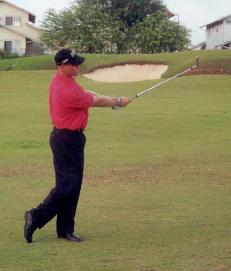
The picture to the left once again
demonstrates how my swing
points through toward to the
target. Notice how dynamic this
point to the target action looks.
In this particular case it is
actually point parallel left of my
target.
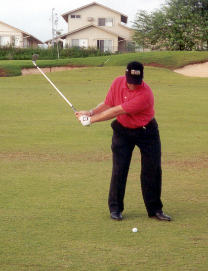
The picture far left shows the
starting position for the
point-swing-point exercise.
This is where you rehearse
the point to the target position
before you swing.
The picture on the right shows
the swing-point toward the
target position. Notice how it
looks more dynamic than the
rehearsal point position (far
left).
The picture far left shows the
swing-point to the target
follow-thru executed in the
swing-point-swing exercise.
The picture on the right shows
the correlating position in an
actual swing as I played a shot
on the golf course. Although
they are not perfect copies of
each other, they are very, very,
similar. I believe they are so
similar because I train the drill
often enough to have it show
up in my actual swings.
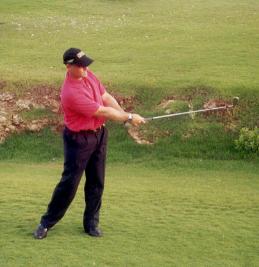
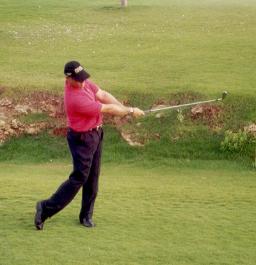
Both sets of pictures above and below demonstrate the basic point-swing-point exercise. #1- Start by rehearsing the basic point to the target position (left). #2- Swing back to a 1/2 swing backswing (middle). #3- Then swing thru to a point to the target follow-thru (right). |
The follow-thru demonstrated in the above picture shows a clubface that is square to my sternum and my arms and hands are centered in front of me. |
The follow-thru in the center picture shows a follow-thru that has rolled over and is pointing left of my target. The picture on the right shows a follow-thru that has rolled under and is pointing to the right of my target. |
In Summary, as you perform the point-to-the-target actions pay attention to these checkpoints: Does your dominant hand control the back-n-thru motion? Does your club point-down-the-target-line in the follow-thru? Does your clubface swing square-to-square & inside-to-inside? Is your weight on the forward foot as you follow-thru? Does your chest face the target, and Does your rhythm feel long-n-smooth? |
| New Horizons Golf Approach I n n o v a t i v e C o a c h i n g F o r G o l f e r s |
As you develop your follow-thru action many of you will notice a very direct point-to-the-target follow-thru feel (As demonstrated in the pictures above). However, some swing styles have more of what can be called a cornering follow-thru. Some of you may feel a tracing-the-arc follow-thru as compared to a tracing-the-line follow-thru. Though a cornering follow-thru, or tracing-the-arc type of follow-thru, may have either the feel or appearance of following thru left of a traditional target-line, these types of follow-thrus do follow-thru toward the target. The down the line interval of a cornering follow-thru is simply shorter than those of a tracing-the-line follow-thru. Though the down the line interval is shorter, they still maintain an on-plane relationship. I understand that the above descriptions fail to give enough information to help those that need to train a cornering follow-thru. However, the intent of this page to describe the basic activity and feel instead of describing all possible ways of following through to the target. It is simply fundamental to find a way of following through in a target-oriented manner. And some follow-thrus point to the target at waist-high, some have a trace-the-arc feel, and some have a cornering feel. If you feel it difficult, or find it difficult, to point-to-the-target as depicted in the pictures above, study the tracing-the-arc actions. These actions will be discussed in future webpages. They will be related to side-on arm swings, on-top arm swings, torso plane swings, and covering actions. Do to time constraints, it may be a while before these pictures and topics will be uploaded. Please feel free to e-mail your questions if you are interested in guidance. perceived. The way you perceive the feel of your swing may fail to match up with how you visualize the swing Also realize, your feel may not describe the dynamics of your swing. Feel is indeed real, however it is you just made. You can think of the language of your body (your feelings) as being a different language than that of your mind (thoughts and visualizations). This being the case, there may not be a direct translation from the language of feel to the language of visualizations. So, even though your follow-thru may feel like it traces the arc left, it can still satisfy the fundamental of following through down the line to your target. If you'd like to read more about how feel is real and how it relates to swing dynamics, then visit the miscellaneous page. A link will be added to that page in the near future. |
| If you have any questions regarding New Horizons Golf Approach please contact EA Tischler at (408)203-7599, or email your questions to EA Tischler newhorizonsgolfer@yahoo.com. |
 |  |  |  |  |  |  |


Follow-thru to your target!
 | |  | |  | |  | |  | |  | |  |
 | |  | |  | |  | |  | |  | |  |
 | |  | |  | |  | |  |
| want you to remind yourself to be target-oriented. Lastly, remind yourself to keep your focus on the fundamentals – Remember, you’re developing your fundamental routine. Your first goal will be developing the feeling of following-thru in a target-oriented manner. This is because the first fundamental is following-thru to the target. Your second fundamental goal will be maintaining a square clubface. Blending the two fundamentals with long-n-smooth rhythm will satisfy a sense of good feel. Let’s get to training. Head out to the range, pick a nice spot, and select a wedge or short iron. Line up 4 or 5 balls in a row, and set-up for a swing. If you want, you can simply train at home without balls. Just imagine where your target is, and where the balls will fly. Hold the club in your right hand only, then point the club at your target. As you point the club at your target, face the target as well. Hold this position for a couple of moments, then make a one-handed swing back-n-thru to your target. Swing smooth enough that you can feel your right hand in control, and swing slow enough so that you can feel the club point back toward your target. Make as many swings as you need to awaken the basic feeling of following through in a target oriented manner. Once you have the feeling with your dominant hand only, repeat the process with both hands holding the club. Remember, at the beginning of each rehearsal-swing, point the club toward the target while facing the target. Then rehearse swinging back-n-thru while staying focused on your target. Both starting and finishing in this position will strengthen your focus of following-thru to your target. Here are some checkpoints to help you assess the quality of your follow-thru position. The first checkpoint is to notice whether most of your weight is on your forward foot, back foot or flat on both feet. The second checkpoint is to notice whether the clubface is square to your sternum, or whether it has rolled open or closed. Finally, notice how firmly you are holding the club in your right hand. Conversely, notice if your non-dominant hand is relaxed or in a death grip. I’m sure you’ll find that a firm dominant hand grip with a relaxed non-dominant hand grip will give you the most natural control. As you continue paying attention to your follow-through and where the ball is flying, the arc of the swing travels approximately waist-high to waist-high. Remember, your training starts small and builds on the fundamentals. Once you perform the waist-high swings consistently, you can train half-swings, followed by shoulder-high swings. Although your half-swings and shoulder-high swings will follow-thru past the point where you feel you are pointing toward the target, return the club to that position after completing your follow-thru. Returning the club will continually re-enforce the commitment of being target-oriented. Many golfers try to make their swing travel straight back-n-thru on the target line, and the tend to fail with their ball striking skills. Accomplished golfers know that the club needs to swing inside-to-inside. They know this because the club must travel around the golfer’s posture, which means the club swings on an angled swing plane. And, this dictates that the clubface swing on a path inside the target line during the backswing, out to the line through the ball, then inside the line during the follow-thru. So try to feel a more inside- to-inside swing path as you swing the club back-n-thru to your target. This also means that when we talk about when we talk about the feel of following through to the target it is more of a feel than a precise alignment. In fact many golfers are actually pointing the club parallel left of the target when they feel they are following through to the target. Others golfers will actually be pointing the club more downward toward the plane line when they feel the target oriented follow-through. The point here is that we are trying to develop a feel through awareness instead of trying to develop a precise alignment. |
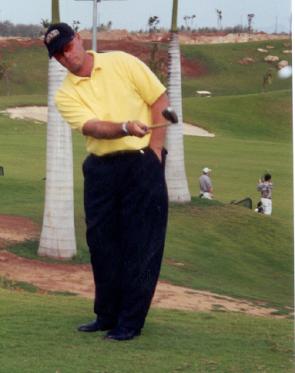
| The above picture demonstrates the basic dominant hand (only) point toward the target position. Notice how the ball is flying & where the club is pointing. |
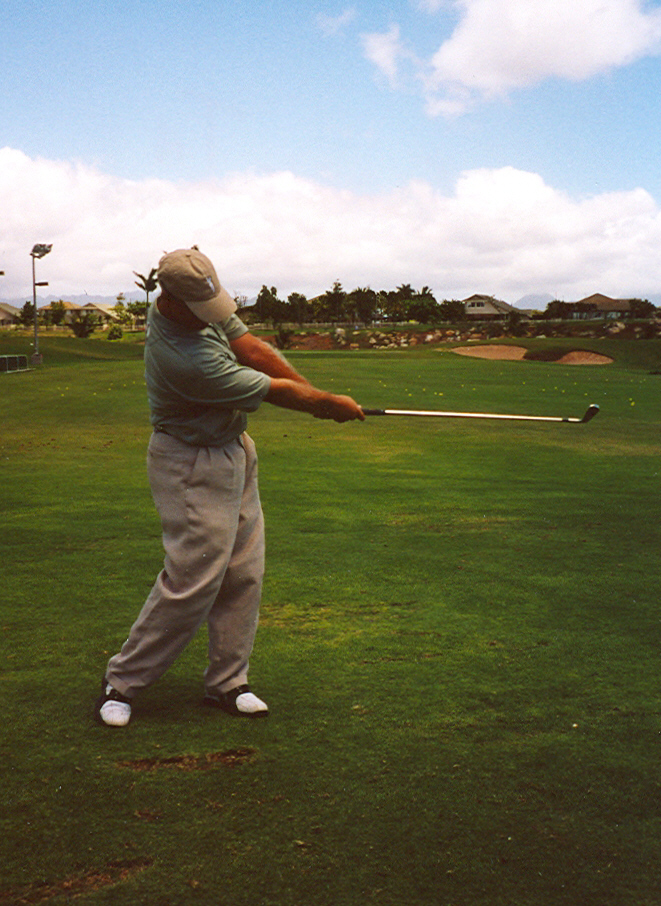
| The above picture two handed follow-through position. |

Above is the newest Edition of The Way Of The Golfer. It can
be purchased on-line at a variety of on-line book sellers.
However authorhouse.com regularly offers the lowest prices.
be purchased on-line at a variety of on-line book sellers.
However authorhouse.com regularly offers the lowest prices.
Golf - The Timeless Game is a great book for developing your
fundamental skills. It covers all skills from putting to wedge play
to the long game. If you want to purchase this book you need to
buy it directly from E.A. Tischler. Send a purchase request by
email to E.A. Tischler at newhorizonsgolfer@yahoo.com
fundamental skills. It covers all skills from putting to wedge play
to the long game. If you want to purchase this book you need to
buy it directly from E.A. Tischler. Send a purchase request by
email to E.A. Tischler at newhorizonsgolfer@yahoo.com

New Horizons Golf Approach is also a great book for
developing your fundamental skills. It covers the basic long
game fundamentals, athleticism and some inner game issues
you need to address to play your best golf. If you want to
purchase this book you need to buy it directly from E.A.
Tischler. Send a purchase request by email to E.A. Tischler
at newhorizonsgolfer@yahoo.com
developing your fundamental skills. It covers the basic long
game fundamentals, athleticism and some inner game issues
you need to address to play your best golf. If you want to
purchase this book you need to buy it directly from E.A.
Tischler. Send a purchase request by email to E.A. Tischler
at newhorizonsgolfer@yahoo.com

Above is Fore54 Scoring Secrets. This book will be available
Pocket Coaches volumes 9, 10, and 11 along with Stage 4
Inner Game skills need to execute those skills on the golf under
the pressures of playing the game. Developing your skills is
one thing, performing them when you have to is another.
Pocket Coaches volumes 9, 10, and 11 along with Stage 4
Inner Game skills need to execute those skills on the golf under
the pressures of playing the game. Developing your skills is
one thing, performing them when you have to is another.
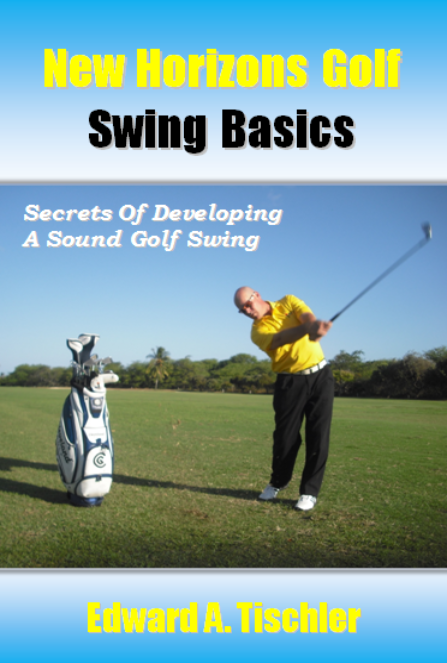
This book covers the New Horizons Golf Approach Fundamental
skills, Ball Striking Skills, Power Stacking Skills and address
Stage 4 playing the game skills. In it you will get the same
information as in Pocket Coach Volumes 2, 4, 5 as well as
valuable Stage 4 playing the game information.
skills, Ball Striking Skills, Power Stacking Skills and address
Stage 4 playing the game skills. In it you will get the same
information as in Pocket Coach Volumes 2, 4, 5 as well as
valuable Stage 4 playing the game information.

To purchase full coler eBook click on PayPal
button. Remember to provide your email
address. ebooks are emailed within 48 hours
of purchase.
button. Remember to provide your email
address. ebooks are emailed within 48 hours
of purchase.
To purchase full coler eBook click on
PayPal button. Remember to provide your
email address. ebooks are emailed within
48 hours of purchase.
PayPal button. Remember to provide your
email address. ebooks are emailed within
48 hours of purchase.
To purchase eBook click on PayPal
button. Remember to provide your
email address. ebooks are emailed
within 48 hours of purchase.
button. Remember to provide your
email address. ebooks are emailed
within 48 hours of purchase.
To purchase eBook click on PayPal
button. Remember to provide your
email address. ebooks are emailed
within 48 hours of purchase.
button. Remember to provide your
email address. ebooks are emailed
within 48 hours of purchase.
To purchase eBook click on PayPal button.
Remember to provide your email address.
ebooks are emailed within 48 hours of purchase.
Remember to provide your email address.
ebooks are emailed within 48 hours of purchase.
To purchase full coler eBook click on PayPal
button. Remember to provide your email
address. ebooks are emailed within 48 hours
of purchase.
button. Remember to provide your email
address. ebooks are emailed within 48 hours
of purchase.

MAKING YOUR GOLF SIMPLE APP AVAILABLE - CLICK ON THE PICTURE BELOW FOR MORE DETAILS: